
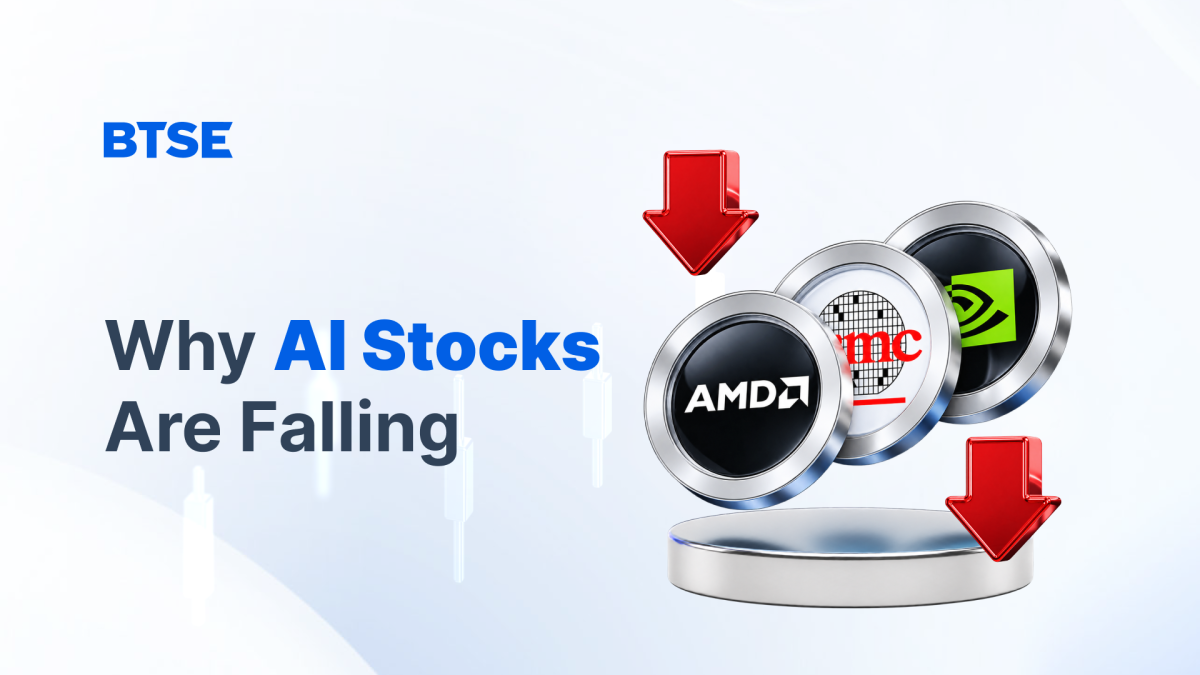
Why are AI stocks falling after one of the strongest chip rallies in years? In the first half of October 2026, the companies that make the memory inside AI servers took the hardest hit in the AI chip stocks selloff 2026 investors had been bracing for. This guide walks through what happened, why memory stocks move in cycles, and how to think about whether AI stocks are in a bubble without the hype.
Why Are AI Stocks Falling? The October Selloff in Numbers
To see why AI stocks are falling so sharply, start with the memory makers.
Over five trading days, SK Hynix dropped 26%, Samsung fell 22%, and Micron lost about 11%. Measured across the full seven-session slide that began on October 6, Samsung shed 23.9% and SK Hynix 31.5% in Seoul.
Because these two companies make up a large share of South Korea’s market, the index followed them down. On October 15, the Kospi fell nearly 8% into a bear market and paused trading for 20 minutes as selling deepened. If this feels familiar, it is a sequel to the July swing covered in our look at SK Hynix and the earlier memory chip selloff.
As of October 19, memory names such as SK Hynix had started to bounce, so the question of why AI stocks are falling is really a question about what changed in early October. The answer comes down to three pressures hitting at once.
What Triggered the AI Chip Stocks Selloff 2026
The first spark came from China. ChangXin Memory Technologies, known as CXMT, announced plans for a server memory product built on a new architecture that could pack in more storage, raising fears it could win market share. Reports of that progress stoked competition fears and led US memory stocks lower on October 13.
The second pressure was interest rates. Worries about a possible Federal Reserve rate hike weighed on chip stocks alongside AI funding concerns. Higher rates make it more expensive to borrow, and the AI buildout runs on borrowed money.
The third was AI debt itself. Market watchers noted that credit investors were becoming picky about AI debt, and the global hardware rout extended on AI funding worries. Put together, the AI chip stocks selloff 2026 traders lived through was less about one headline and more about several doubts landing in the same week.
SK Hynix Samsung Memory Cycle Explained: Why Chip Stocks Swing
Here is the SK Hynix Samsung memory cycle explained in plain terms, starting with what the two companies sell. DRAM is the short-term working memory inside computers, and HBM (high-bandwidth memory) is a stacked, faster version that sits next to AI processors. When AI demand surged, supply of both got tight, and prices jumped.
Samsung is a slightly different case from SK Hynix. Its phone, foundry and display businesses can soften or amplify memory swings, as our Samsung stock perps explainer breaks down.
Memory has a long history of boom and bust. A shortage pushes prices up, companies spend heavily on new factories, and once that capacity comes online, supply can overshoot demand and prices fall. That is why investors watch capacity plans as closely as earnings.
This month, a South Korean newspaper column warned of possible memory oversupply by 2029, which added to the pressure. Other analysts were skeptical, with one saying CXMT’s progress was unlikely to swing the supply-demand balance. Micron, the third major memory maker, faces the same cycle, and its moves can be followed on the MU perpetual futures market.
Are AI Stocks in a Bubble? Both Sides of the Debate
The bear case starts with valuations. Investors have been unnerved by AI company valuations as more voices question how long data center demand can last. Some observers compare the scale of AI infrastructure spending to America’s historic railroad boom, a period remembered for both progress and painful overbuilding.
The bull case points to fundamentals. Analysts in Seoul argued the selloff reflected weak buying support rather than weaker earnings, with next year’s forecasts being revised up on expectations of a deeper supply shortage. Even after the losses, the US chip index was still up more than 70% for the year as of mid-October.
So, are AI stocks in a bubble? There is no consensus answer, and both sides are working from the same data.
Rather than asking whether AI stocks are in a bubble, it can be more useful to ask which parts of the trade depend on borrowed money. What the October move shows is that sentiment around the sustainability of the AI trade can shift quickly, even when company results look strong.
What AI Chip Stocks Traders Are Watching Next
The next big test is earnings. SK Hynix is scheduled to report third-quarter results on October 28, with Samsung following on October 29. Those reports will show whether memory pricing and HBM demand are holding up, and whether the AI chip stocks selloff of 2026 has run its course.
Beyond earnings, traders following AI chip stocks are watching interest rate expectations, any update on CXMT’s production yields, and whether the Kospi can stabilize. The Federal Reserve meets October 27 to 28, and our week-ahead macro outlook tracks the data that could move rate expectations before then. Each of these can move memory names sharply in either direction, and together they will shape how SK Hynix, Samsung and the memory cycle play out into 2027.
Trading Memory Chip Moves With Stock Perpetual Futures
Stock perpetual futures let you take a long or short view on a share price without an expiry date, as explained in our guide to stock perpetual futures. On BTSE, SK Hynix has two contracts that track different listings. SKHYNIX-PERP follows the Seoul-listed common share in US dollars, while SKHY-PERP follows the Nasdaq ADR, which represents only a fraction of one Seoul share, so their prices are not directly comparable.
Futures trading on BTSE uses a dedicated futures wallet that is separate from your spot wallet, so funds must be transferred manually before you trade. With multi-asset collateral, you can post several supported assets as margin once they are in the futures wallet.
Perpetual futures provide price exposure only, with no share ownership, dividends, or voting rights, and leverage can magnify losses as well as gains, so review how liquidation and partial liquidation work before opening a position.
If you want to follow the memory cycle as it unfolds, create your BTSE account and explore the Samsung perpetual futures market, the SK Hynix Seoul share perpetual, or the SK Hynix ADR perpetual.